Seawater desalination technology upgrade | Say goodbye to high energy consumption, low water production, and excessive concentrate! Coupled technology completely outperforms traditional desalination solutions.
Currently, the vast majority of seawater desalination projects in China still use the single traditional reverse osmosis process , which generally faces common industry problems such as high energy consumption per ton of water, insufficient water production rate, easy clogging and damage of membrane modules, rising operation and maintenance costs year by year, and failure to meet the standards for concentrated brine discharge . Many coastal plants, island projects, and offshore platforms appear to be in operation, but in reality, they are plagued by problems such as high water costs, unstable water quality, heavy environmental compliance pressure, and frequent shutdowns for maintenance.
To completely solve the industry's pain points and achieve low energy consumption, high water production, zero pollution, stable operation, and long-term low-cost water use, the upgraded "pretreatment + reverse osmosis desalination + deep water purification + evaporation zero-emission coupled process" is the preferred and mature solution in the current seawater desalination field, far surpassing traditional processes. It is also the mainstream technology for high-standard industrial and ecological control zone projects.
I. Complete standardized seawater desalination process (professional closed loop, quality improvement at each stage)
1. Seawater intake + multi-stage pretreatment (equipment protection, anti-clogging membrane)
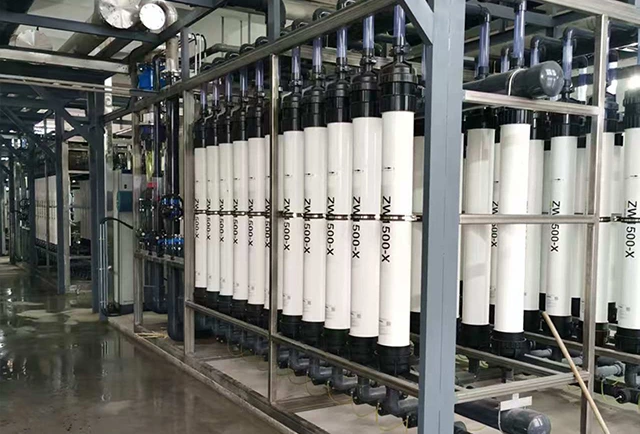
Addressing the challenges of nearshore seawater characterized by abundant sediment, algae, and complex colloidal impurities, the raw water intake first passes through coarse and fine screens to intercept shells, gravel, and floating debris. Then, a coagulation and sedimentation process removes suspended solids, turbidity, and organic pollutants. Subsequent multi-stage purification, including multi-media filtration, activated carbon filtration, and precision security filtration, thoroughly filters out fine impurities, stabilizing the influent water quality to the optimal operating conditions for the reverse osmosis membrane. This prevents membrane fouling, scaling, and corrosion at the source, significantly reducing the probability of downstream equipment failure.
2. Reverse osmosis core desalination (high-precision seawater purification)
Pre-treated seawater is pressurized by a high-pressure pump, and coupled with a high-efficiency energy recovery system, the high-pressure energy consumption is significantly offset. The water flows into the anti-fouling reverse osmosis membrane module, where, through the principle of physical high-pressure screening, impurities such as salt, heavy metals, bacteria, and microorganisms in the seawater are precisely removed, achieving a stable ultra-high desalination rate of over 99.8% . At this stage, the seawater undergoes brine separation, producing primary desalinated water, while simultaneously separating high-salinity concentrate, achieving separate and classified treatment based on water quality.
3. Deep purification and disinfection of freshwater (meets drinking water standards/high-standard industrial water standards)
The primary desalinated water undergoes pH adjustment to optimize taste and water quality indicators. It then undergoes a dual disinfection process using ultraviolet light and ozone to completely inactivate residual bacteria and microorganisms, preventing secondary pollution. For high-requirement applications such as boiler feedwater and precision industrial pure water, an EDI deep purification module can be added to ultimately produce finished desalinated water that fully meets national standards for drinking water and industrial production water, ensuring stable water storage and pressure control, and providing a reliable water supply around the clock.
4. Resource utilization of concentrated wastewater through evaporation (upgraded process, compliant zero discharge)
Unlike the traditional, crude process of directly discharging concentrated wastewater, this process is equipped with an MVR low-temperature evaporation/vacuum evaporation system , forming a closed loop of reverse osmosis and evaporation coupling. It deeply concentrates, evaporates, and condenses the high-salt wastewater at the downstream end, recovers and reuses the water, and disposes of a small amount of crystalline salt solid waste in a compliant manner. This completely solves the problems of excessive wastewater discharge and damage to marine ecosystems, making it suitable for projects in areas with strict environmental inspections and those requiring zero emissions.
II. Core Differentiating Advantages of Our Coupling Process vs. Traditional Industry Processes
1. Energy efficiency advantage: Overcomes the industry's common problem of high power consumption, resulting in significant long-term cost reduction.
Traditional single-phase reverse osmosis processes in the industry have no energy recovery or low recovery efficiency, with energy consumption typically at 3-4 kWh per ton of water. Electricity costs account for more than 45% of the overall operation and maintenance costs, resulting in persistently high electricity costs year-round. Our system is equipped with a 97% ultra-high efficiency energy recovery device, combined with an energy-saving optimization design for the evaporation process, significantly reducing energy consumption per ton of water to less than 2.5 kWh . Compared to conventional equipment in the industry, the overall energy cost is reduced by 35%-50%, saving hundreds of thousands of yuan in electricity expenses in the long run.
2. Water Production Advantage: Breaking through the industry's water production rate bottleneck, doubling water resource utilization rate.
Conventional seawater desalination processes on the market rely solely on single-stage reverse osmosis, achieving a water production rate of only 45%-55%. Nearly half of the seawater is directly wasted as concentrate, resulting in significant water extraction costs and water resource losses. Our coupled process utilizes an evaporation system to recycle concentrate for secondary purification, increasing the overall water production rate to over 90% , far exceeding the industry average. This makes it particularly suitable for projects with limited water access and high water extraction costs, such as those on islands and offshore platforms.
3. Operation and maintenance advantages: Solves the industry's problems of membrane clogging, short lifespan, and frequent maintenance.
The industry standard for equipment pretreatment is generally simple and lacks antifouling capabilities. Seawater impurities easily clog membrane modules, resulting in a conventional membrane lifespan of only 3-5 years. Frequent chemical cleaning is required, leading to extremely high costs for membrane replacement and manual maintenance. In some near-shore eutrophic waters, equipment even fails prematurely in less than two years. Our approach utilizes multi-stage precision pretreatment combined with antifouling-specific reverse osmosis membranes, effectively resisting seawater algae, colloids, and scaling. This extends the membrane module lifespan to over 5 years , significantly lengthens the cleaning cycle, and reduces maintenance failure rates and consumable replacement costs by more than 40% compared to the industry average.
4. Environmental advantages: Say goodbye to the industry's pain point of direct discharge of concentrated wastewater, 100% compliance guaranteed.
Currently, most competitors' traditional processes only allow for simple treatment followed by direct discharge of concentrated brine, which easily leads to excessive salinity in surrounding waters, ecological damage, and poses a significant risk of environmental inspections, rectification, and work stoppages. Our complementary evaporation and crystallization process achieves a fully closed-loop, zero-discharge system for concentrated brine, with no wastewater discharge and no ecological pollution. It fully complies with marine environmental management standards, ensuring long-term compliant and stable operation of the project.
5. Operating advantages: Adaptable to complex and poor-quality seawater, with stability far exceeding that of ordinary equipment in the industry.
Conventional equipment in the industry has poor adaptability to high-salinity, turbid, and polluted seawater, and fluctuations in water quality can easily lead to a decrease in desalination rate and equipment downtime. Our coupled process combines the advantages of high-precision membrane desalination with the evaporation method's ability to withstand high salinity, is unaffected by fluctuations in seawater quality, high-salinity dry seasons, and near-shore polluted waters, and provides stable desalination throughout the year with no pressure on continuous equipment operation . It is suitable for seawater desalination projects in all regions and scenarios.
In summary, compared to the industry's traditional single desalination process, our reverse osmosis + evaporation coupled closed-loop process truly achieves "lower energy consumption, higher water production, less maintenance, greater compliance, and more stable operation," completely solving the three major pain points of the seawater desalination industry: high cost, high failure rate, and high environmental risk.