From "summer salt production" to "winter alkali harvesting": Sodium chloride and potassium chloride combine The chemical wisdom behind crystals
On the vast shores of the saline-alkali lake, an ancient wisdom persists: "Dry salt in summer, harvest alkali in winter." This is not only...
The working people's philosophy of survival in accordance with nature is a vivid illustration of the principle of crystallization in chemistry in real life.
When we turn our attention to common sodium chloride (table salt) and potassium chloride (potassium fertilizer), we find that their...
Extraction and separation perfectly illustrate the two core chemical processes of evaporation crystallization and cooling crystallization. Today, let me...
Let's uncover the scientific mysteries behind these two crystallization methods together.
Solubility curve: The "command stick" that determines the crystallization mode
To understand crystallization, we must first understand the "temperament" of substances—their solubility. Different substances have different solubilities in water.
The degree to which the solution capability is affected by temperature varies greatly.
Sodium chloride (NaCl) is a typical "slow-rising" solubility substance. Its solubility is only slightly affected by temperature changes.
The amount of sodium chloride that can dissolve in 100 grams of water is negligible; regardless of the cold winter or the sweltering summer, the mass remains almost unchanged.
Therefore, attempting to cause a large amount of sodium chloride to precipitate out by cooling is tantamount to trying to catch fish by climbing a tree.
In contrast, potassium chloride (KCl) exhibits very different properties. Its solubility varies with temperature.
A significant increase in temperature indicates a "sharp increase" in concentration, classifying it as a "steeply increasing" substance. Potassium chloride dissolves in large quantities in hot water, but once...
When the temperature drops sharply, its solubility plummets, leaving potassium ions that were originally dissolved in water with nowhere to hide.
It can precipitate in crystalline form.
It is this difference in solubility sensitivity to temperature that determines their respective most suitable crystallization pathways.
Evaporation and Crystallization: The Dehydration Path of Sodium Chloride
For sodium chloride, whose solubility is not significantly affected by temperature, the "evaporation-solidification" method is commonly used in industry and laboratories.
Crystallization method.
Its core logic is very simple: since cooling doesn't work, just reduce the solvent (water). By adding...
Heat or natural wind and sun exposure cause water to evaporate continuously, gradually changing the solution from unsaturated to saturated, eventually reaching supersaturation.
Saturated state. At this point, excess sodium chloride will precipitate out in crystal form. This is the "summer salt production" along the shores of Qinghai Lake.
It is by taking advantage of the hot and windy climate of summer that the water evaporates faster, thus causing the salt to crystallize and precipitate.
Crystallization from a hot saturated solution: The "cooling" magic of potassium chloride
For potassium chloride, the "cooling thermal crystallization method" (referred to as cooling crystallization) is required.
Machine Translated by Google
This process consists of two steps: the first is "thermal dissolution," which involves preparing a saturated solution of the substance at a relatively high temperature.
At this point, the solute is fully dissolved; the next step is "cold precipitation," which involves allowing the hot, saturated solution to cool naturally or be forcibly cooled.
As the temperature decreases, the solubility of potassium chloride drops sharply, and the solution instantly becomes "overloaded," releasing a large amount of chloride.
Potassium crystals will then precipitate out like snowflakes.
In the industrial production of high-purity potassium chloride, potassium-containing brine is often concentrated first and then sent to a crystallizer.
Cooling. Because potassium chloride is extremely sensitive to temperature, it will preferentially crystallize in large quantities upon cooling, while its solubility will not change significantly.
Large impurities such as sodium chloride mostly remain in the mother liquor. After centrifugation, high-purity sodium chloride can be obtained.
Potassium products.
The Art of Crystallization: The Ultimate Application of Separation and Purification
When sodium chloride and potassium chloride are mixed together, the crystallization method demonstrates its powerful ability to separate and purify them.
If we want to separate and extract a small amount of potassium chloride from a large amount of sodium chloride, we can use sodium chloride and chlorine...
Given that the solubility of potassium chloride varies with temperature, a combination of 'evaporation first, then cooling' is typically employed.
Process: First, sodium chloride, whose solubility is less affected by temperature, is precipitated out in large quantities through evaporation and crystallization, and then purified while hot.
Filtration and separation were performed; subsequently, the mother liquor rich in potassium chloride was cooled and crystallized, taking advantage of the decreasing solubility of potassium chloride with temperature.
The low and rapid decrease in temperature causes it to precipitate; this method not only perfectly solves the problem of separating the two salts, but also...
In real-world industrial scenarios such as ash washing at the sintering machine head and potassium extraction from salt lakes, efficient resource recovery and environmental protection have been achieved.
Win-win.
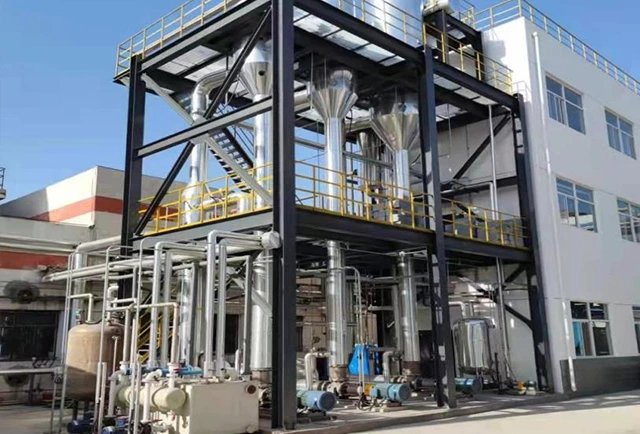
From laboratory beakers to massive crystallization towers in industrial production, from table salt to potassium in farmland
Evaporation crystallization and cooling crystallization are not only topics tested in chemistry textbooks, but also crucial for humankind to utilize the properties of matter and modify it.
A magnificent practice of creating nature. Mastering these two crystallization methods is to hold the key to unlocking the door to the separation of matter.