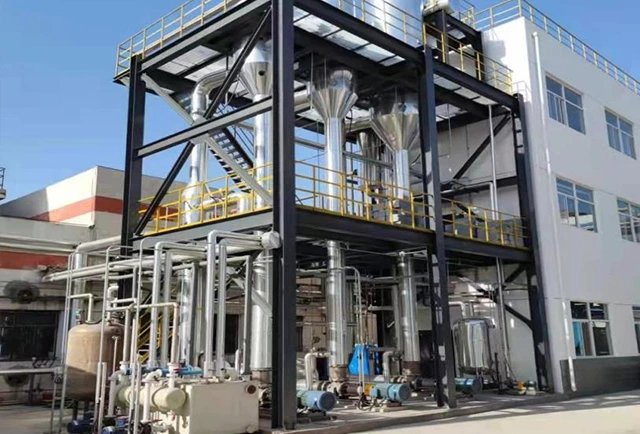
Low-temperature evaporation and concentration version VS scraper version
A comprehensive guide: Which types of water should be concentrated? Which types of water must be scraped with a spatula?
Breakdown of the entire treatment process, including volume reduction rate, effluent quality, pretreatment, crystallization, and posttreatment.
In recent years, with increasingly stringent environmental regulations and rising pollution discharge costs, the reduction, resource utilization, and treatment of industrial wastewater have become increasingly important.
Zero emissions have become a necessity for manufacturing enterprises. Among the many emission reduction technologies, low-temperature evaporation (low-temperature vacuum evaporation) stands out.
With its advantages of low operating temperature (30-45°C), low scaling, good effluent quality, and controllable energy consumption, the [product name] can be used to [achieve other benefits].
It has quickly become the main process for treating high-salt and high-concentration wastewater.
However, in actual selection, many homeowners and engineering companies encounter the same problem:
What's the difference between the concentrated and scraper-type water filters? Which one should I choose for my water quality?
Choosing the wrong option can lead to anything from frequent downtime for cleaning to equipment failure and project failure.
This article will take the perspective of a core technical staff member, following the steps of applicable water quality ÿ pretreatment ÿ volume reduction effect.
ÿ Effluent water quality ÿ Crystallization ÿ Post-treatment – This complete process will be explained thoroughly, breaking down the two models. After reading this…
This allows you to accurately determine which model is right for your specific working conditions.
First, let's understand how low-temperature evaporation works.
Whether it's the concentrated version or the scraper version, the underlying principle is the same; the difference lies in "what to do when it's concentrated to its limit."
~
Low-temperature evaporation uses a vacuum pump to evaporate the evaporation chamber to a negative pressure state (-90 kPa). -95kPa), so that the wastewater is in
It can boil and evaporate at a low temperature of 30-45°C. The water vapor is condensed and discharged as distilled water, while the pollutants remain.
In the concentrate. This process consumes only 1/5 to 1/8 of the energy required for atmospheric pressure evaporation.
Process flow:
Wastewater feed ÿ Preheating heat exchange ÿ Vacuum negative pressure evaporation (30-45°C boiling) ÿ Steam condensation
ÿ Distilled water output
ÿConcentrate discharge method (core difference)
Concentrated version: Pumps out liquid concentrate | Scraper version: Mechanical scrapers scrape out slurry/crystallization
II. Concentrated Version – A High-Value "Mainstay"
Suitable for wastewater with good flowability and low scaling and crystallization resistance, it can be concentrated through circulation. +
Pumping to remove concentrated water reduces the volume of water.
2.1Applicable water quality
The concentrated version is suitable for wastewater with TDS ÿ 80,000 mg/L, low viscosity, and no obvious tendency to crystallize.
Typical water quality includes:
RO (Reverse Osmosis) concentrate
•Electroplating rinse water
•Machine cutting fluid and emulsion wastewater
•Various types of cleaning wastewater
•Dyeing and printing wastewater
•Nanofiltration/ultrafiltration concentrate
•General saline industrial wastewater
2.2Reduction Effect
Typical reduction rates are 85%-95%. Taking RO concentrate as an example, with an influent volume of 10 tons/day, the concentrate volume after concentration is approximately 0.5-1.5%.
The volume reduction effect is significant. The concentration ratio is usually controlled between 5 and 20 times, depending on the TDS of the raw water. Concentration ratio
The higher the concentration level, the smaller the volume of concentrate, but the greater the risk of scaling, requiring precise control of the concentration endpoint.
2.3Effluent Water Quality
Distilled water with COD ÿ 50-100 mg/L, conductivity ÿ 50-200 ÿS/cm, stable water quality, and colorless.
Transparent. In most cases, it can be directly discharged into the sewer system or reused as greywater. The effluent quality is unaffected by fluctuations in the influent concentration.
The impact is because evaporation is essentially a phase change separation process, and non-volatile pollutants are almost 100% trapped within it.
In the concentrate.
2.4Preprocessing Requirements
Concentrated formulations are highly dependent on pretreatment; the following are the core requirements:
Suspended solids filtration: Particles ÿ100ÿm must be intercepted; a two-stage filtration system consisting of a bag filter and a precision filter is recommended.
filter
Oil and grease removal: Floating oil/dispersed oil must be pretreated by an oil separator or air flotation; otherwise, an oil film will form on the heat exchange surface.
Significantly reduce evaporation efficiency
Defoaming control: Wastewater containing surfactants requires the addition of defoamers or the installation of mechanical defoaming devices to prevent foam trapping.
Contaminated distilled water
pH adjustment: The feed pH is best between 6 and 9. If it is too acidic, alkali should be added to neutralize it in order to protect the equipment materials.
Hardness control: If calcium and magnesium ion levels are too high, it is recommended to pre-soften/remove the hardness to reduce the risk of scaling on the heat exchange surface.
2.5Crystallization Risks and Management
The concentrated version is not designed with a crystallization function. Once concentrated to near saturation, scaling easily forms on pipes and heat exchange surfaces.
Blockage. Therefore, the concentration endpoint must be strictly controlled, and the concentrate must be drained before crystallization occurs. Operators must follow the instructions...
The timing of discharge concentration is determined by the influent TDS and experience.
Machine Translated by Google
2.6Post-processing
The concentrate needs to be disposed of as hazardous waste through an external contractor, or further reduced in volume by downstream drying/solidification equipment. Distillation
If high-purity water needs to be reused, it can be further treated by RO or ion exchange.
3.Scraper Type – The Hardcore Player That Can "Scrape Out Crystals"
The built-in scraper agitator continuously removes deposits from the heat exchange surface, effectively handling highly viscous, easily scaled, and even directly deposited substances.
Collect the wastewater that has crystallized.
3.1Applicable water quality
The scraper version is suitable for extreme water conditions with TDS ÿ 80,000 mg/L, high viscosity, high COD, and a tendency to scale and crystallize.
Water quality. Typical water qualities include:
•High-salt, high-concentration mother liquor (TDS up to 200,000+ mg/L)
•Desulfurization wastewater (power plant/steel plant flue gas desulfurization)
•Landfill leachate RO concentrate
•High-salt process wastewater from chemical plants
•MVR evaporator mother liquor (secondary concentration)
•High-concentration pharmaceutical residue
•Steel pickling waste liquid
3.2Reduction Effect
The volume reduction rate can reach 95%-99%+, achieving near-dryness or crystallization. The concentration factor can reach 20-100.
The efficiency is more than double that of other materials, and the moisture content of the residue can be as low as 10%-30%. For zero-emission projects, the cost of the scraper blade is often the primary expense.
The role of "terminal solidification" is a key device for bridging the last mile.
3.3Effluent Water Quality
Distilled water COD ÿ 30-80 mg/L, conductivity ÿ 20-100 ÿS/cm. This is due to the use of thin-film evaporation.
This method allows for more thorough gas-liquid separation, and the effluent quality is generally superior to that of concentrated solutions. However, please note that it may contain volatile organic compounds.
Wastewater containing VOCs may have a high COD level, requiring subsequent activated carbon or biochemical treatment.
3.4Preprocessing Requirements
The scraper type has a higher tolerance for pretreatment, but basic pretreatment is still indispensable:
Large particle interception: Hard particles ÿ1mm must be intercepted to protect the scraper and heat exchange surface from scratches.
Degreasing recommendations: Although scrapers have a certain degree of oil resistance, a large amount of grease will coat the scraper, reducing its scraping effect.
and heat exchange efficiency
Machine Translated by Google
Defoaming treatment: Same as the concentrated version, foam entrainment can contaminate distilled water.
pH and corrosion protection: If the acidity or alkalinity is too strong, neutralization is required, and corrosion-resistant materials (such as duplex steel, titanium, etc.) should be selected.
Greater tolerance: It is far more tolerant of suspended solids, viscosity, and scaling tendency than the concentrated version, which is due to the scraper.
One of the core advantages
3.5Crystallization ability
This is the core advantage of the scraper-type product—it can directly achieve crystallization. The scraper continuously agitates the concentrate and...
After scraping off the deposits on the heat exchanger walls, as the moisture continues to evaporate and the salt concentration reaches supersaturation, it transforms into crystals/slurry.
The process involves precipitation, achieving a one-step transformation from "waste liquid to solid salt." It is suitable for processing sodium chloride, sodium sulfate, sodium nitrate, and other non-ferrous metals.
The recycling and reduction of organic salts.
3.6Post-processing
Crystallized salt slurry can be dewatered using a centrifuge or plate and frame filter press to obtain solid salt with a moisture content of 10%-20%.
Depending on the composition and purity of the salt, it can be further utilized as a resource (such as in snow-melting agents or as a raw material for industrial salt), or used as a...
Solid waste/hazardous waste disposal—but the volume and weight are significantly reduced compared to liquid concentrate. Distilled water is reused.
The requirement is to connect a subsequent fine treatment system (RO/EDI/activated carbon, etc.).
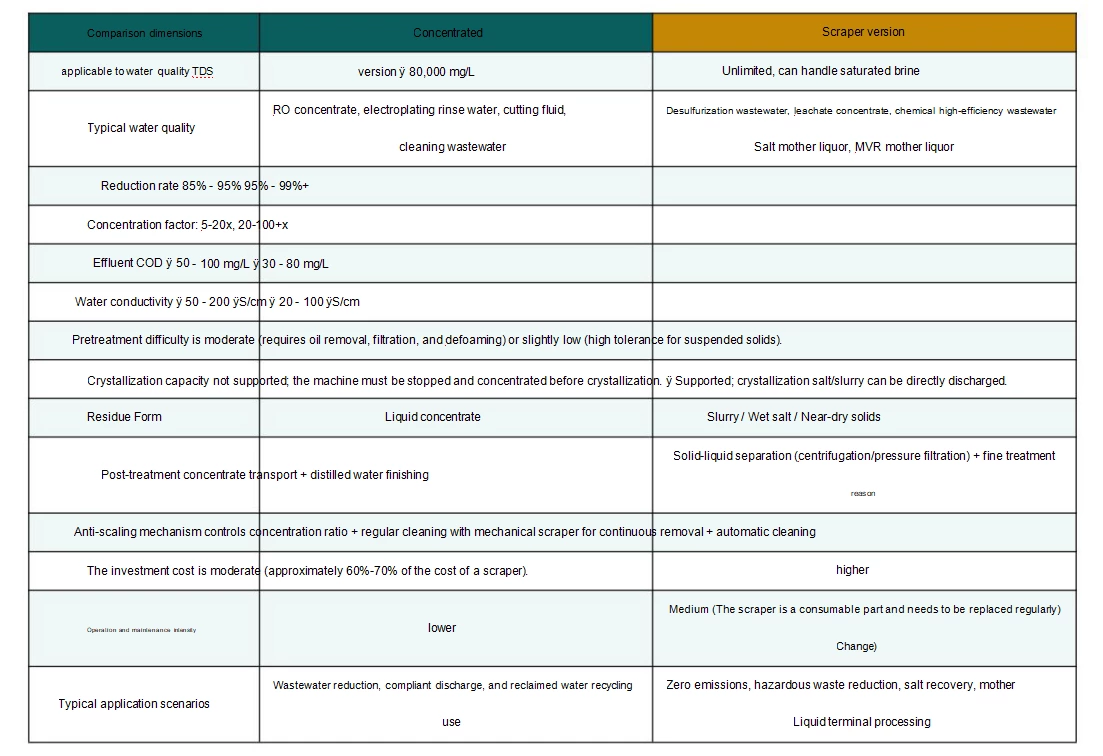
A single table reveals: A comprehensive comparison of the concentrated version and the scraper version.
V.In-depth analysis of the pre-processing stage – determining how long the equipment can "survive"
Low-temperature evaporation is not a "one-size-fits-all" solution. If pretreatment is not done properly, even the best equipment will malfunction frequently.
5.1Key Points for Pre-processing Concentrated Formulations
Suspended solids filtration: Particles ÿ100ÿm must be intercepted. Recommended configuration: Bag filter (200ÿm).
Two-stage filtration: a 100ÿm (m) filter and a precision filter (100ÿm).
Oil and grease removal: Floating oil/dispersed oil must be treated by an oil separator or dissolved air flotation (DAF). Recommended oil content in the effluent.
ÿ50mg/L. The oil film formed on the heat exchange surface by grease can reduce the heat transfer coefficient by 40%-60%.
Defoaming control: Wastewater containing surfactants produces a large amount of foam during evaporation, and the foam entrainment can lead to increased COD in distilled water.
The foam level is soaring. It is necessary to add silicone-based defoamers or install a mechanical defoamer.
pH adjustment: The feed pH should be controlled between 6 and 9. Acidic wastewater (pH < 4) significantly corrodes stainless steel.
It needs to be neutralized by adding NaOH or Ca(OH)ÿ.
Hardness control: When the concentration of calcium and magnesium ions is too high, CaCOÿ/CaSOÿ will preferentially increase during the heat exchange process.
Surface precipitation. Pre-softening treatment is recommended when the total hardness of the influent is >300mg/L.
5.2Key Points for Pre-treatment of Scraper Strips
Large particle interception: Hard particles ÿ1mm (such as sand, gravel, and metal shavings) must be intercepted to prevent scratches and abrasions.
Blade and heat exchanger inner walls. Self-cleaning filters or basket filters are recommended.
Degreasing recommendations: While scrapers can remove some grease through mechanical scraping, large amounts of grease will...
Encasing the scraper blades reduces scraping efficiency and affects heat conduction.
Defoaming treatment: Similar to the concentrated version, the severe foam entrainment significantly affects the quality of distilled water, making defoaming pretreatment essential.
Omit.
pH and corrosion resistance: Extreme pH environments require neutralization treatment and the selection of corrosion-resistant materials—duplex stainless steel.
(2205), titanium (TA2) or Hastelloy.
Advantages in tolerance: Compared to the concentrated version, the scraper version is more tolerant of suspended solids concentration, viscosity, and scaling tendency.
This is an order of magnitude higher. This is its greatest engineering value—reducing the risk of preprocessing failure.
In short: Concentrated formulations heavily rely on pretreatment; pretreatment is their "lifeline"; scraper
This product has a high tolerance for pretreatment, but basic filtration, defoaming, and pH adjustment are still indispensable.
VI.Crystallization and Post-processing: The final step from "water" to "salt"
This is the key link that determines whether the entire process chain can be truly closed.
6.1Post-processing path for concentrated formulations
Concentrated solutions do not crystallize; the concentrate is discharged in liquid form (typically with a water content of 70%-85%), and subsequent processing routes include...
include:
•Outsourced disposal: The concentrate is treated as hazardous waste and handed over to a qualified disposal company for treatment. The disposal cost is approximately [amount missing].
2000-5000 yuan/ton
•Drying and curing: Further dehydration is performed in a paddle dryer or drum dryer until the moisture content is <20%.
•Incineration: High-calorific-value organic concentrates can be sent to incinerators for disposal.
•Distilled water purification: Followed by RO (reverse osmosis) or EDI (electrodeionization) system to meet the requirements for high-purity water reuse.
beg
6.2Crystallization and Post-processing Path of Scraper-type Crystallization
The scraper-type tool can directly induce crystallization, which is then discharged as a brine slurry (with a water content of approximately 30%-50%). Subsequent...
The path includes:
•Centrifugal dehydration: Horizontal screw centrifuge or pusher centrifuge; after dehydration, the moisture content of the solid salt is 10%-20%.
•Plate and frame filter press: Suitable for fine-crystalline salts, with a moisture content of 15%-25% after dewatering.
•Resource utilization: Depending on its purity, crystalline salt can be used in de-icing agents, as a raw material for industrial salt, and as an additive in building materials, etc.
•Terminal disposal: The amount of solid salt that cannot be recycled is only 1/5 to 1/10 of that of liquid concentrate.
Significantly reduced installation costs
6.3Universal Post-treatment of Distilled Water (Both Methods Applicable)
Distilled water produced by low-temperature evaporation is generally of better quality than the standards for municipal water supply (COD ÿ 100 mg/L, conductivity ÿ 100 mg/L).
200 ÿS/cm). According to reuse requirements:
•Direct discharge meeting standards: Applicable to scenarios where the effluent indicators meet local water supply standards.
•RO purification: Further desalination, product water conductivity can reach ÿ10ÿS/cm
•Activated carbon adsorption: Removes residual VOCs and trace organic matter.
•EDI High-Purity Water: RO+EDI combined process, producing water with a resistivity ÿ15Mÿ·cm, meeting the requirements for precision cleaning/
Boiler water supply requirements
VII.Quick Selection Guide: Determine which model you should use in 30 seconds
Choose the concentrated version if your situation meets most of the following criteria:
•Wastewater has good fluidity and low viscosity
•TDS ÿ 80,000 mg/L
•No obvious tendency to crystallize/scale
•A reduction rate of 85%-95% is sufficient to meet the demand.
•Limited budget, seeking the best value for money
•The concentrate has outsourced disposal channels.
Choose the scraper type if your situation meets any of the following criteria:
•TDS is extremely high (nearly saturated or oversaturated).
•Water with high viscosity, prone to scaling and crystallization
•Target reduction rate ÿ95%, or even require direct solid output.
•Terminal concentration/solidification for zero-emission projects
•Treatment of extreme water quality such as MVR mother liquor, desulfurization wastewater, and high-salt chemical mother liquor.
•The goal is to produce solid salt, which would significantly reduce the amount and cost of hazardous waste disposal.
7.1 Best Practice: Concentrated Formula + Scraper Formula Combination
Many large-scale projects do not actually offer a "choose one or the other" solution, but rather combine both approaches:
Front-end concentrated version (mainly reduces volume, large processing capacity, low cost) ÿ Back-end scraper version (terminal curing,
(Make the most of it)
This combined approach balances treatment costs and reduction depth, making it the mainstream configuration for large-scale zero-emission projects.
The front-end concentration unit handles the reduction of tens of tons of wastewater daily, shrinking its volume to 5%-15% of the original; the back-end...
The end scraper then further solidifies the 5%-15% concentrate, ultimately achieving near-zero liquid discharge.
VIII.In Conclusion
There is no "best" low-temperature evaporation method, only the "most suitable." Concentrated versions offer the best value for money, covering a wide range of applications.
Over 70% of industrial wastewater reduction scenarios; the scraper-type scraper is the ultimate weapon, specifically designed to tackle high-salt, high-viscosity, and easily...
Crystallized "hard bones".
If your project is facing the challenge of wastewater reduction or zero discharge, it is recommended to first conduct a complete water quality analysis (pH, etc.).
(TDS, COD, hardness, oil content, suspended solids concentration, and main salt composition) – make selection decisions based on this data.
Instead of making decisions based on experience.
Welcome to contact Jiangsu Gaojie for a one-on-one technical assessment – we will base our assessment on your actual water quality data.
According to the information provided, customized process solutions and equipment selection suggestions are given.