Seawater desalination system
The mainstream technology routes for seawater desalination systems are thermal and membrane methods. The following is a detailed explanation of the core principles:
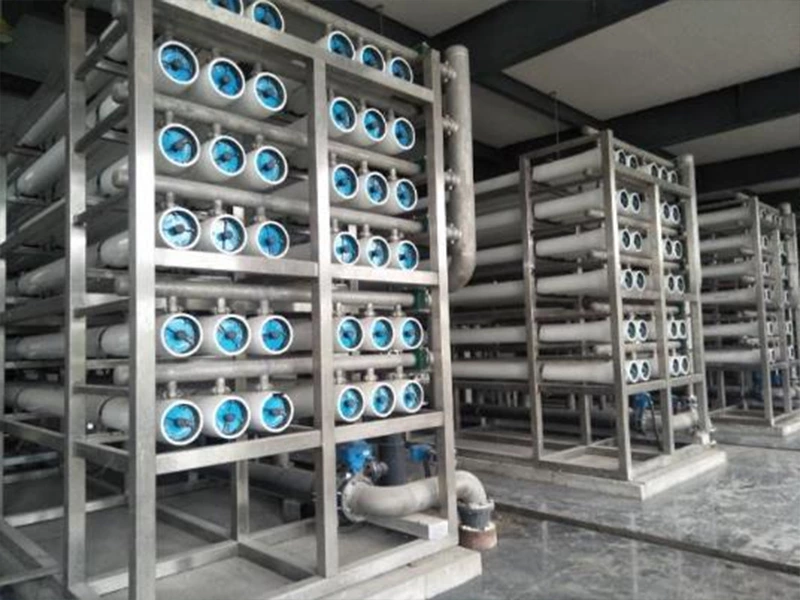
1、 Core of membrane method: reverse osmosis (RO) technology
- Core mechanism: By utilizing the selective permeability of semi permeable membranes, an external pressure of 5.5-6.8 MPa is applied to seawater, overcoming the natural osmotic pressure of seawater and forcing water molecules to reverse pass through the membrane, intercepting more than 99.8% of salt, bacteria, and impurities.
- Complete process: The seawater is first subjected to pre-treatment such as sand filtration and activated carbon adsorption to remove suspended solids, and then pumped into the membrane module by a high-pressure pump to produce fresh water that meets pH standards. Concentrated saltwater can recover 95% of pressure energy through an energy recovery device, significantly reducing operating energy consumption.
2、 Mainstream Thermal Method: Distillation Technology
- Low temperature multi effect distillation (MED): Multiple evaporators are connected in series, and the secondary steam generated by the previous effect is used as the heat source for the next effect. The seawater is evaporated in a vacuum environment below 70 ℃, and the steam is condensed to obtain high-purity fresh water with a salt content as low as 5mg/L.
- Multi stage flash evaporation (MSF): Pre treated high-temperature seawater is sequentially introduced into a flash evaporation chamber with gradually decreasing pressure. The seawater is rapidly flashed and vaporized, and steam is condensed to obtain fresh water. The technology is mature and reliable, and it is suitable for combined use with power plant waste heat to achieve hydropower generation.
3、 Other auxiliary technologies
- Electrodialysis method: Under the action of an external direct current electric field, a cation exchange membrane is used to selectively migrate salt ions in seawater, achieving the separation of salt and water. It is commonly used in low salinity brackish water desalination scenarios.
- Freezing method: allowing seawater to freeze at low temperatures, causing salt to precipitate from ice crystals. After separating and washing the ice crystals, they melt to obtain fresh water, which has low energy consumption but poor taste. It has not been widely used for commercial purposes.